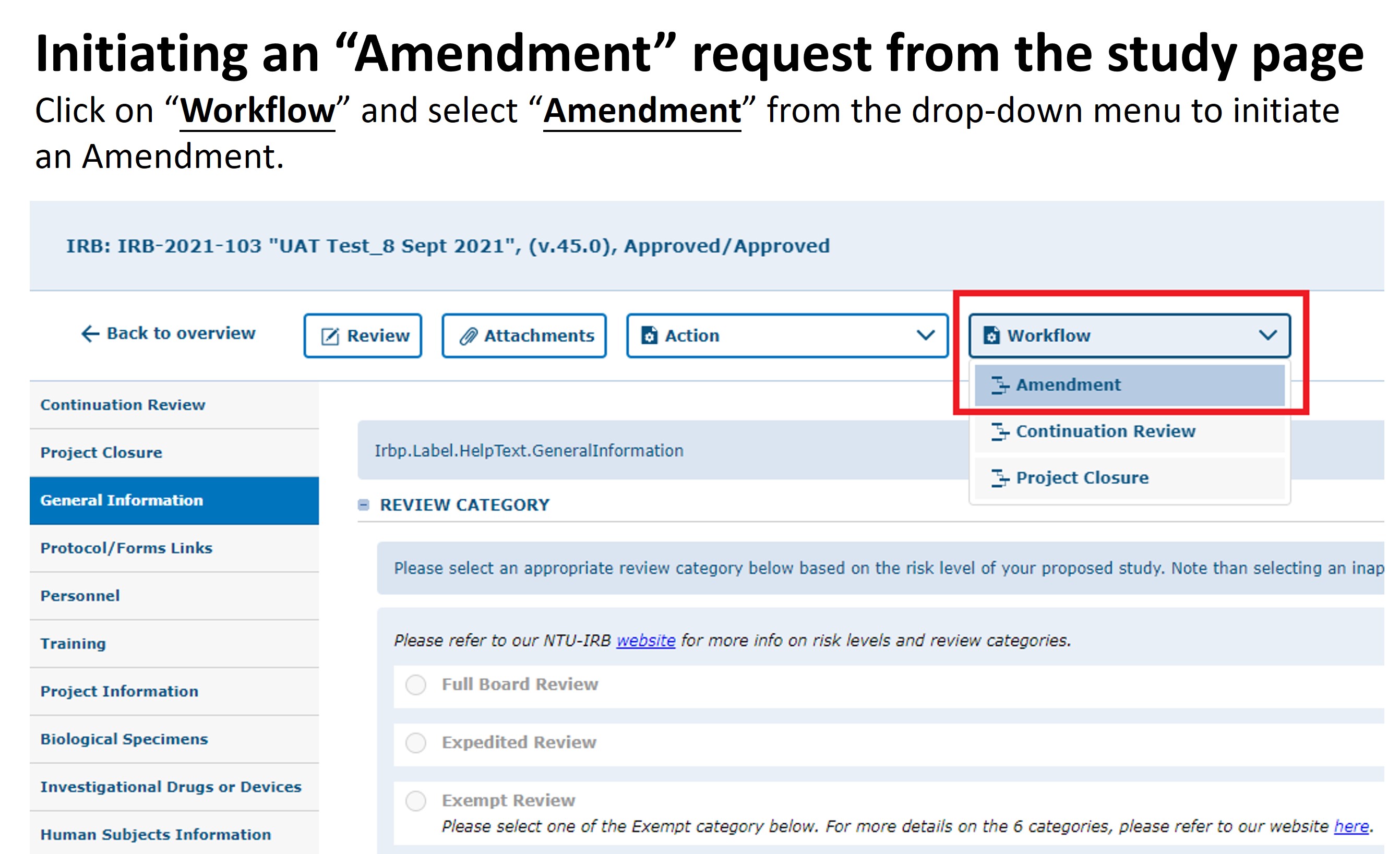
Amendments to Approved Applications
PIs and study teams are required to adhere to their IRB-approved applications, including the protocol, target recruitment numbers, consent form, recruitment materials, data storage procedures, etc.
If changes to the approved study are needed, PIs must:
- Submit an amendment to NTU-IRB
- Obtain approval before implementing the change
Examples of Changes Requiring Amendment
Changes affecting any of the following (including but not limited to):
- Study design or procedures
- Participant eligibility criteria or study population
- Participant Information Sheet (PIS) and Informed consent documents or debrief or consent script (for oral consent)
- Recruitment materials (e.g., posters, social media posts, email templates, call scripts)
- Study instruments (e.g., questionnaires, surveys, interview scripts)
- Study team composition
- Addition of new research sites not previously approved
- Increase in recruitment numbers
Exception:
Changes may be implemented without prior IRB review and approval only if there is an immediate safety risk to participants. Such changes must be reported promptly to NTU-IRB.
Important Note:
If amendments are conducted without prior approval, they will be considered as protocol deviations. These are:
• Considered as Non-Compliances, and will be followed up by NTU-IRB.
• Considered as contraventions under the Human Biomedical Research Act (HBRA) and may be reportable to relevant authorities.
It is the PI’s responsibility to ensure that all modifications comply with the IRB’s requirements.
If you are unsure whether a modification requires review and approval, please consult with the IRB at irb@ntu.edu.sg.
PIs are encouraged to plan ahead to reduce the need for future amendments and avoid subsequent research delays/disruptions, while ensuring participant safety and study integrity.
1. Incorporate Pre-defined Study Parameters into Study Design
Where appropriate and scientifically justified:
- Use visit windows rather than fixed study timepoints. E.g. 2nd visit in "Week 2" instead of stating "Day 8"
- Group similar research sites (e.g., MOE schools, ECDA childcare centres, community facilities) instead of listing individually. (Note: Research sites operating under mutually recognised IRBs or healthcare institutions should be listed individually).
- “Research Vendors/Partners” may be used instead of naming specific vendors where identity is not critical to participant safety, rights, welfare, or study integrity.
2. Document Study Personnel Appropriately
The following personnel should be listed in the IRB application:
- Principal Investigator (PI)
- Co-Investigators (NTU and external)
- Site Principal Investigators (NTU and external)
- NTU Study Team Members performing research procedures
The following personnel may be recorded in the study delegation log instead of in the IRB application:
- NTU personnel not performing research procedures (e.g., supporting participant reimbursement, data cleaning, or analysis of anonymised data).
- External study team members under supervision of an external Site-PI.
Note PI’s responsibilities:
- Ensure all study team members are appropriately trained before undertaking assigned study responsibilities.
- Maintain an accurate and up-to-date delegation log for all study team members.
Note: Delegation logs may be reviewed during Compliance Monitoring or continuing review.
1. Minor Administrative or Document Updates
Amendment is not required if changes do not affect study design, risk, or participant understanding, such as:
- Typographical or grammatical corrections that do not alter the meaning of the content.
- Formatting or cosmetic changes (e.g. colour scheme or font type of recruitment materials).
- Updates to contact details, address, document dates, or version numbers (provided content of the document remains unchanged).
- Changes to the data collection/storage platform or tool, provided that the new platform or tool complies with the NTU Data Governance Policy (DGP).
2. Study Reductions
Amendment is not required if the reduction does not affect study risk, participant safety, or wellbeing, such as:
- Reduction in recruitment targets.
- Reduction in number of research sites.